
Squid Game Hacked Your Brain. Here’s Exactly How It Did It.

Michael Sorrenti
I help companies design products people can’t stop using | Creative Technologist | Product design & AI Advisory | Builder for Disney, ESPN, Mattel, Marvel & Nickelodeon | Founder, Game Pill
Squid Game became a global obsession not just because of its shocking violence or emotional story, but because the show is a perfect example of how to use deep human motivations to keep people watching.
It follows a framework called Octalysis developed by Yu-kai Chou, which breaks down eight core drives that power all of our actions, and the show hits every single one of them hard. That is why viewers cannot stop thinking about it long after the credits roll the design works on a psychological level that most entertainment never touches.
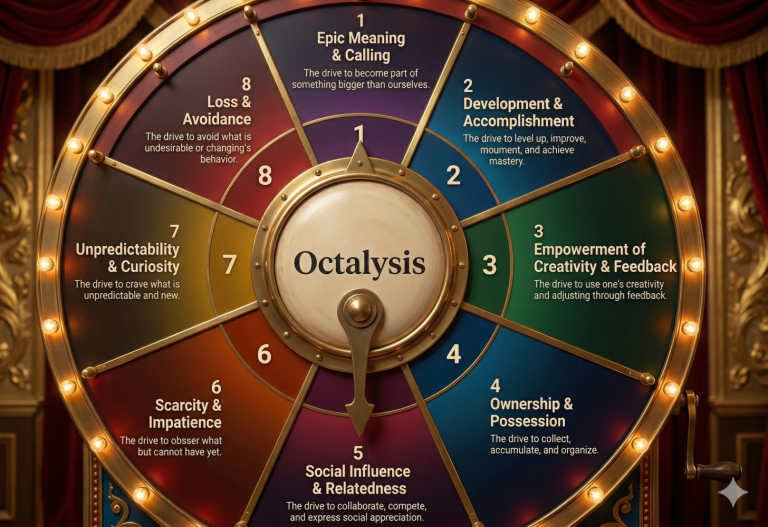
The Motivations
Motivation 1. “You Were Chosen” — Epic Meaning & Calling
The first drive is epic meaning and calling, and this makes people feel like they are part of something bigger than themselves.
In Squid Game, the players believe they were chosen for a special event, and the games are framed as a once-in-a-lifetime opportunity to change everything. The Front Man and the VIPs treat the competition like a grand system with rules and traditions, and even the audience starts to feel this drive when you ask yourself, “What would I do in that situation?” That question pulls you deeper into the story because it forces you to imagine your own place inside this terrible world.
This drive makes the players tolerate horrible conditions because they convince themselves that their suffering has meaning. The prize money is not just cash, but rather freedom, dignity, and a second chance at life and that belief keeps them returning to the playground even after watching people die. Epic meaning transforms a deadly competition into a sacred mission, and that transformation is what makes the players willing to risk everything again and again.
A real-world company that uses epic meaning well is Patagonia . The outdoor clothing brand connects every purchase to environmental activism, donating a portion of all sales to conservation projects. Customers feel like they are joining a movement to save the planet, not just buying a jacket, and this sense of purpose turns casual shoppers into loyal advocates who spread the message to their friends.

Motivation 2. Level Up or Die — Development & Accomplishment
The second drive is development and accomplishment, and humans love to see progress because we want to level up and hit milestones. Squid Game delivers this constantly. Winning a round feels like passing a test, and the cash prize grows with every death. That huge piggy bank hanging above the dormitory acts as a visual progress bar for survival, while each game offers a measurable milestone surviving Red Light Green Light, completing the honeycomb challenge, crossing the glass bridge. This structure creates a powerful loop of effort and reward that keeps players engaged even when they are terrified.

In Squid Game, the stakes make accomplishment feel even bigger because players do not just earn points — they earn their own survival. The show highlights each victory with dramatic music and slow-motion shots, and survivors return to the dormitory with a palpable mix of relief and pride. That feeling of achievement is addictive because it comes after real fear, and the show makes you crave that release again and again as you watch each new round unfold.
LinkedIn uses development and accomplishment to keep users engaged. The platform shows you a profile completion percentage while encouraging you to add skills, endorsements, and recommendations. Every time you fill in another field, you get a small celebration, and that progress bar makes updating your resume feel like playing a game. You want to reach one hundred percent just for the satisfaction of finishing.
Motivation 3. Lick the Candy or Lose Your Life — Empowerment of Creativity & Feedback
The third drive is empowerment of creativity and feedback. People love to solve problems and see immediate results in everything they do. Squid Game forces players to adapt quickly: in the honeycomb game, you must lick, heat, or carefully pick apart a brittle sugar shape without breaking it. Tug of war requires teamwork and an understanding of physics — you cannot just pull harder but instead need timing, footwork, and a plan. The glass bridge pushes players to calculate risk based on what they can see in front of them.
The feedback is instant and brutal: your idea either works or you die, and that clarity makes every decision feel massive.
The extreme feedback in Squid Game makes every decision matter. Players cannot rely on luck alone but must observe, think, and act with purpose. One character survives the honeycomb game by licking the back of the candy, while another survives marbles by tricking her partner in a moment of cruel genius. These moments make the audience feel smart too, because you start planning what you would do in each game and that mental participation hooks you even deeper than the violence alone ever could.

Duolingo uses empowerment of creativity and feedback in a much safer way. The language learning app gives you different types of exercises: translating sentences, matching words, speaking into your microphone. Each answer gets immediate feedback with a satisfying sound effect, and if you get it wrong you know right away and can try again without real consequence. That quick loop keeps you engaged for hours because you are constantly learning and adjusting.
Motivation 4. That Money Is Already Mine — Ownership & Possession
The fourth drive is ownership and possession, and this is one of the strongest forces in Squid Game because the money starts to feel like it already belongs to the players.
They see the piggy bank fill up with cash earned from other people’s deaths, and they calculate what they will buy, what debts they will pay, and how their lives will change forever. This imagined ownership makes them desperate to protect their investment, and even alliances become possessions as players talk about “my team” and “my partner” with fierce loyalty that cannot be broken easily.

In the marble episode of Squid Game, this drive becomes heartbreaking because two partners who trusted each other must now compete for a single win where one person will live and one will die. Each player feels ownership over their partnership and over the hope they built together across several brutal days. The show forces them to choose between loyalty and survival, and that tension is almost impossible to watch. But you cannot look away because you have become invested in both characters by that point.
Apple uses ownership and possession brilliantly with its ecosystem. When you buy an iPhone, you start to feel like your apps, photos, and messages belong on Apple devices. You buy AirPods next because they work seamlessly with your phone, then you consider an iPad or a Mac because each purchase makes the previous ones more valuable. You become invested in staying inside the Apple world, and that sense of ownership keeps customers coming back for years without ever thinking about switching.
Motivation 5. Trust Me. I’ll Kill You Later. — Social Influence & Relatedness
The fifth drive is social influence and relatedness, and humans are wired to connect with others in ways that shape our every decision. Squid Game turns this drive into emotional warfare. Friendships form under extreme pressure as players share food, comfort each other, and promise to split the money. Then the show forces them to betray those same friends, and the betrayals hurt more because the relationships were real, built through shared suffering. Team selection creates an instant “us versus them” mentality, so you root for your favorite group and fear the others as the games continue.

The marble episode is pure social psychology weaponized. Players must choose a partner only to discover that only one of them can survive. Every interaction becomes a negotiation: some players sacrifice themselves for love while others lie and cheat without hesitation. The show exposes how quickly social bonds can break under pressure, yet those bonds also make the story unforgettable because you remember the friendships more than the games themselves long after watching.
Starbucks uses social influence and relatedness to build customer loyalty. The coffee chain creates a “third place” between home and work where people meet friends, study in groups, or hold business meetings. Starbucks encourages customers to post their drinks on social media with the logo visible, and that sharing makes people feel like they belong to a community that spans the entire world. You are not just buying coffee you are participating in a lifestyle that millions of others share.
Motivation 6. Only One Spot Left — Scarcity & Impatience
The sixth drive is scarcity and impatience, and when something is limited we want it more than ever before. Squid Game creates scarcity everywhere: limited spots in the competition, limited time to complete each game, limited food in the dormitory, limited safety behind the pink-suited guards, and limited trust among players who might turn on you at any moment. This constant urgency forces action because players cannot wait or think for too long — they must act now or lose everything they have fought for.

In Squid Game, even basic needs become scarce. Sleep is hard to come by when the lights stay on and fights break out constantly. Food comes in small portions that barely keep you alive, and privacy does not exist in any form. This scarcity breaks down normal social rules and makes players more desperate and more willing to take risks. As a viewer, you feel that scarcity too — you keep watching just to know who survives each new challenge.
Booking.com uses scarcity and impatience to drive bookings with messages like “Only one room left at this price” or “Ten people are looking at this hotel right now.” Those alerts create a fear of missing out, so you feel like you have to decide immediately before the opportunity disappears forever. Countdown timers for deals make your heart beat faster until you book the room just to stop the pressure.
Motivation7. You Never See It Coming — Unpredictability & Curiosity
The seventh drive is unpredictability and curiosity, and the human brain craves new information more than almost anything else. Squid Game runs on this drive completely. Players never know what the next game will be, and the rules are hidden until the last second. Characters die unexpectedly — the show kills people you thought were safe while sparing others you expected to lose early on. Twists happen constantly: the old man is the games’ creator, the cop secretly infiltrates the island, and the Front Man turns out to be the missing brother of that very cop.

Squid Game keeps you asking three questions constantly: what is the next game, who dies next, and who is really running this place behind the masks? The show answers just enough to keep you satisfied but not enough to make you stop wondering, and each answer leads to a new question that pulls you forward. That cycle is the engine of binge-watching. You tell yourself you will watch one more episode, but that episode ends on a twist — and then you need one more, and then one more, until the sun comes up.
Netflix itself uses unpredictability and curiosity to keep you subscribed. The recommendation algorithm suggests shows you might like but never reveals the full list at once. You have to scroll and discover, and each row of titles is a mystery box. You watch the trailer because the description hooks you, then start the first episode because you are curious about how it begins. Netflix designs this entire journey to feed your curiosity one step at a time without ever fully satisfying it.
Motivation 8. Walking Away Means Losing Everything — Loss & Avoidance
The eighth drive is loss and avoidance, and this is the strongest force in Squid Game because people will work harder to avoid losing something than to gain something new. The players face debt outside the game that feels worse than death. They owe money to violent loan sharks and have already lost their families and their dignity. Returning to real life means facing that pain again, so they keep playing even when the odds are terrible. Each round creates sunk cost pressure because they have already lost friends, shed blood, and endured nightmares that will never leave them.

In Squid Game, death is always present and that makes the fear real and immediate for every single character. Players see bodies removed from the dormitory and hear gunshots during every game as a constant reminder of what awaits the losers. The show also uses loss avoidance with the voting system: players can vote to end the games and split the money among the dead, but most choose to continue because they have already lost too much to walk away now.
Amazon Prime uses loss and avoidance to keep members renewing. Once you sign up for a yearly subscription, you start taking advantage of free shipping and video streaming right away. You add family members, buy more often because shipping is easy. Then when renewal comes, you think about losing all those benefits — about paying for shipping again, or losing access to shows you love. That fear of loss is stronger than the excitement of joining was in the first place, and you renew without thinking twice.
The Psychological Stack That Makes Squid Game Impossible to Quit
Squid Game combines all eight core drives into one simple package. It gives you high stakes from loss avoidance alongside progression from development and accomplishment. It gives you social betrayal from relatedness, mystery from unpredictability, and scarcity of time, safety, and resources all at once. All of this happens inside a structure everyone already understands — childhood games — so playing Red Light Green Light as a child was fun and safe, but playing it in Squid Game is terrifying, and that contrast makes the show unforgettable.
The key design trick Squid Game uses is stacking multiple drives together until they become unstoppable. Players believe “I already suffered this far, so I deserve the reward.” That sentence combines ownership, loss avoidance, and accomplishment all at once. The same stack works in fitness apps, loyalty programs, and subscription services across every industry. Understanding why Squid Game hooked the world can help anyone design better experiences whether for entertainment, education, or business because these eight drives live inside every human being on the planet.
An Example Video Game
Concept Built on All 8 Drives
What would a game look like if it deliberately engineered every single Octalysis drive into its core design? MARKED is a fictional game concept created to illustrate all eight Octalysis drives in a single interactive experience. It is not a real product and is made to illustrate the drives for you to better imagine how they may work in a game or interactive product.
Meet MARKED a high-stakes multiplayer survival game where 100 players compete in a rotating gauntlet of social, physical, and mental challenges inside a neon-lit underground arena. Here is how each of the eight drives lives inside it.
Drive 1: Epic Meaning & Calling — “You Were Summoned”
When a new player logs in for the first time, they do not create a character they are discovered. A cinematic shows the arena AI scanning billions of people worldwide and locking onto them specifically. A voice says: “Out of 8 billion people, the pattern found you. You are not here by accident.”
The arena’s lore reveals that every 10 years, a generation of “Marked” are called to compete for a prize that reshapes the world — not just wealth, but the power to rewrite one law, cancel one debt, or free one person from prison. Players are not just playing a game. They are shaping history. Their in-game actions get archived in a “Legacy Wall” that future generations of players can visit, read about, and build on. The smallest player feels mythologized.
Drive 2: Development & Accomplishment — The Rank Ladder Never Stops
MARKED has 100 visible tiers called Marks. Your Mark number is displayed above your character at all times so every other player can see exactly where you stand. Leveling up triggers a server-wide announcement and a visual burst effect that every player in the arena witnesses simultaneously.
Each game type rewards different skill trees strength, deception, strategy, speed, and social reads so no single player can max everything. Progress is always visible: a persistent dashboard shows your seven skill bars, your current Mark, your best-ever performance, and a countdown to the next milestone unlock. You can see how far you have come and exactly how far you still have to go. The bar never disappears, and it never fully fills.
Drive 3: Empowerment of Creativity & Feedback — No Two Solutions Are the Same
Every challenge in MARKED has at least three valid winning strategies, and the game never tells you which one is best. The Maze Round lets you dig tunnels, bribe other players for shortcuts, or sabotage the map for everyone else. The Signal Round gives you a hidden code that only works when decoded but you can also steal a decoded version from another player, or sell yours to form a temporary alliance.
Feedback is instant and theatrical. Correct moves trigger glowing particle effects and a rising audio tone. Wrong moves produce a sharp red flash and a sound that makes other players turn and look. The environment reacts to you in real time, so clever solutions get rewarded with visible drama that the whole arena notices. Players who find novel strategies get highlighted in post-round replays, creating a viral loop inside the game itself where creativity becomes its own reward.
Drive 4: Ownership & Possession — Build It, Lose It, Fight for It
Every player in MARKED owns a persistent underground cell that they customize between rounds. You earn rare materials through performance, and those materials can be used to build furniture, wall murals, a trophy case displaying past wins, and a personal scoreboard that visitors can read when they pass through your cell. Your cell becomes your identity.
During certain rounds, players can raid other cells. Anything you built can be stolen, damaged, or destroyed. This is terrifying to players who have spent hours building their space, and it triggers an immediate and powerful need to defend what is theirs. The game also features a shared inventory system where alliances can pool resources which means betraying your alliance means losing access to items you helped create together. Possession drives action more than any leaderboard ever could.
Drive 5: Social Influence & Relatedness — Your Allies Are Also Your Enemies
At the start of each MARKED season, players are randomly assigned to crews of five. Crews share a bonus multiplier on all rewards, which means solo players earn less than crew members even when they win. This forces social connection immediately you need your crew to prosper, even if you do not trust them.
But here is the twist: only one player per crew can finish in the top 10 overall. As the season progresses, the crew bonus slowly shrinks while the individual prize grows. Players must decide exactly when to stop cooperating and start competing. The game tracks every promise made in the crew chat and surfaces them during betrayal moments with a notification that reads: “[Player] once said they would never leave you behind.” That single line has ended real friendships and created some of the most emotionally charged moments in gaming.
Drive 6: Scarcity & Impatience — Everything Expires
MARKED runs on a relentless clock. Power-ups appear in the arena for exactly 90 seconds before they vanish. Alliance offers expire in 30 seconds. The most powerful items in the game called Echoes are only available during a 10-minute window once per week, and only 12 of the 100 active players can claim one each week.
Seasonal events drop exclusive cosmetics and lore fragments that are gone forever after the event ends. Former players share these items online, creating a collector culture around lost seasons. First-time players feel the weight of scarcity immediately because veterans wear items that cannot be obtained anymore — visible proof that time is always running out. The game’s entire economy runs on controlled scarcity, and every player feels the clock ticking at all times.
Drive 7: Unpredictability & Curiosity — The Arena Has Secrets
No two sessions of MARKED run the same game twice in a row. The arena AI selects from a pool of 40 challenge types and never announces which is next until players are already sealed inside the room. Player eliminations are also randomized in sequence the scoreboard shows aggregate ranks, not real-time standings, so you genuinely do not know who is winning until the round ends.
The game’s lore is buried across thousands of collectible fragments scattered in hidden corners of the arena. No single player has ever found all of them. Community wikis exist outside the game where players piece together theories about who actually built the arena, what happened to past generations of Marked, and whether the AI running the games has become self-aware. New fragments drop without announcement. Players wake up to find the community has gone wild overnight because someone found a fragment that reshuffled everything they thought they knew. Curiosity never runs dry.
Drive 8: Loss & Avoidance — Everything You Built Can Disappear
MARKED uses permadeath for your season progress, but not for your account. If you are eliminated in a round, you lose all items collected that session, your crew bonus resets, and your Mark drops by three tiers. The items you lose are not destroyed they are redistributed to the player who eliminated you, which means you might see the person wearing your gear in the next session. That sight is deliberately designed to sting.
The game also runs a “Debt System” that mirrors Squid Game’s real-world pressure. Early in a season, the arena offers players powerful items on credit. Use them now, pay back double later. Players who take the debt get a temporary advantage, but as the season winds down and payback comes due, the pressure mounts. Players with debt will play riskier, more desperately, and more aggressively because the alternative — ending the season in debt — carries real in-game penalties. Loss avoidance keeps players in sessions they would otherwise quit, pushes alliances to their breaking point, and creates the same sunk-cost psychology that makes it impossible to leave Squid Game’s arena, or MARKED’s.
Helping Teams Build Products People Can’t Put Down
Michael Sorrenti ti and his team at GAME PILL help companies turn ideas into products people can’t stop using. With 26+ years of experience creating games, AI experiences, and digital platforms for global brands like Disney, Marvel, and Nickelodeon, they guide teams to design and launch products that drive engagement, revenue, and growth. From AI strategy and product design to market-ready execution, the team is able and ready to turn complexity into actionable results.
Sources
Chou, Yu-kai. Actionable Gamification: Beyond Points, Badges, and Leaderboards. Octalysis Media, 2019.
Chou, Yu-kai. “Octalysis: Complete Gamification Framework.” Yu-kai Chou, https://yukaichou.com/gamification-examples/octalysis-complete-gamification-framework/. Accessed 13 Apr. 2026.
“Squid Game.” Netflix, https://www.netflix.com/title/81040344. Accessed 13 Apr. 2026.
“Squid Game Is Netflix’s Biggest Series Ever.” Netflix, https://about.netflix.com/en/news/squid-game-is-officially-netflixs-biggest-series-launch-ever. Accessed 13 Apr. 2026.
Kahneman, Daniel. Thinking, Fast and Slow. Farrar, Straus and Giroux, 2011.
Cialdini, Robert B. Influence: The Psychology of Persuasion. Harper Business, 2006.
Skinner, B. F. Science and Human Behavior. Free Press, 1953.
“Why Squid Game Is So Popular.” BBC, https://www.bbc.com/news/entertainment-arts-58902964. Accessed 13 Apr. 2026.
“Why ‘Squid Game’ Resonates Around the World.” The New York Times, https://www.nytimes.com/2021/10/02/arts/television/squid-game-netflix.html. Accessed 13 Apr. 2026.
“Why We Can’t Stop Watching Squid Game.” Psychology Today, https://www.psychologytoday.com/us/blog/media-spotlight/202110/why-we-cant-stop-watching-squid-game. Accessed 13 Apr. 2026.
“1% for the Planet.” Patagonia, https://www.patagonia.com/one-percent-for-the-planet/. Accessed 13 Apr. 2026.
“Profile Strength.” LinkedIn, https://www.linkedin.com/help/linkedin/answer/a554351. Accessed 13 Apr. 2026.
“Duolingo Learning Method.” Duolingo, https://www.duolingo.com/approach. Accessed 13 Apr. 2026.
“Apple Ecosystem: Lock-In Strategy.” Harvard Business Review, https://hbr.org/2021/02/how-apple-built-a-closed-ecosystem. Accessed 13 Apr. 2026.
“Our Mission.” Starbucks, https://www.starbucks.com/about-us/. Accessed 13 Apr. 2026.
“How Scarcity Messages Influence Booking Decisions.” Booking.com, https://partner.booking.com/en-gb/help. Accessed 13 Apr. 2026.
“Netflix Recommendation System.” Netflix Tech Blog, https://netflixtechblog.com/. Accessed 13 Apr. 2026.
“Amazon Prime Overview.” Amazon, https://www.amazon.com/amazonprime. Accessed 13 Apr. 2026.
#SquidGame #BehavioralDesign #Gamification #Octalysis #Psychology #UserEngagement #ProductDesign #UXDesign #GrowthStrategy #Retention #AddictiveDesign #HumanBehavior #DesignThinking #GameDesign #DigitalProducts #BingeWatching #Netflix #Storytelling #EmotionalDesign #ConsumerPsychology #SaaS #StartupGrowth #AIProducts #ProductStrategy #CustomerExperience #FOMO #HabitForming #EngagementLoops #BusinessStrategy #ContentStrategy