Nobody Cares About Your Booth Until You Give Them a Reason

Michael Sorrenti
I help companies design products people can’t stop using | Creative Technologist | Product design & AI Advisory | Builder for Disney, ESPN, Mattel, Marvel & Nickelodeon | Founder, Game Pill
On a modern show floor, attention isn’t won with better signage. It’s won by interrupting people and the most reliable interruption is play.
Walk any trade show floor and you’ll notice a quiet truth most exhibitors don’t want to hear:
nobody is stopping for your booth.
Not because your brand lacks value. Not because your product isn’t strong. But because in a dense, high-stimulation environment, attention is already fully allocated and static booths rarely earn the right to interrupt it.
The average attendee walks past more than twenty-five exhibits in a single visit, and the average human attention span on a busy floor is now under ten seconds. That is not alot of time.
Rows of banners, screens, brochures, and smiling staff compete in the same invisible battle for attention and most of them lose.
The Attention Problem on the Show Floor
Trade shows are not blank canvases for storytelling. They are overloaded ecosystems. At any given moment, an attendee is navigating physical congestion, filtering hundreds of competing stimuli, prioritizing relevance in real time, and actively trying to avoid cognitive overload.
In that state, traditional booth design assumes something that no longer holds true: that clarity alone drives engagement.
It doesn’t.
Understanding your message requires effort and effort is the one resource attendees are least willing to spend.
The irony is that 92% of attendees come specifically to discover new products and solutions. The audience is motivated. They simply won’t do the work of decoding a wall of text to find you.
Why Most Booths Fail to Break Through
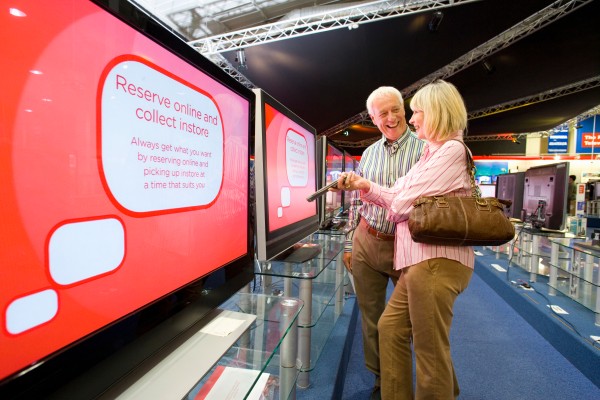
The majority of exhibits still run on passive engagement mechanics: static signage explaining value propositions, looping brand videos, sales reps waiting to initiate conversation, brochures as the primary hook, and product displays that require explanation before they make sense.
Each of these has value but only after attention has already been captured.
The core failure is structural. These booths assume interest will precede interaction. At events, it doesn’t. Interest is the reward for interaction, not the price of admission.
Static booths fail not because they’re poorly designed, but because they’re built for a version of attention that no longer exists. To thrive you must design with interaction in mind.
The Shift: From Communication to Interruption
High-performing booths operate on a different principle entirely.
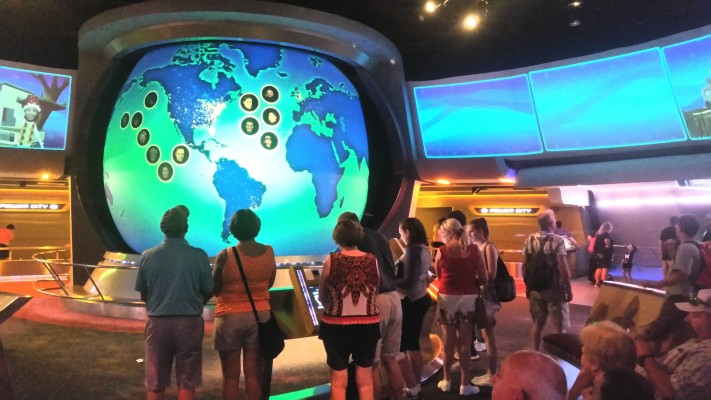
They don’t wait for attention they interrupt it and in some cases demand it. And the most reliable way to interrupt is through interaction. The moment a booth introduces motion, participation, or challenge, it stops being a backdrop and becomes a destination.
The numbers are not subtle.
Interactive booths report average dwell times of five to twelve minutes per visitor, versus roughly 45 seconds for passive displays.
Put plainly: a person who plays a 30-second branded game or activity stays an order of magnitude longer than a person who reads your signage and keeps walking.
Experience is simply harder to ignore than explanation.
Why Interaction Works: The Psychology of Engagement
Interactive booths outperform static ones because they pull several behavioral triggers at once.
■ Curiosity activation. People are drawn to unresolved activity. Visible interaction creates a gap between what’s happening and what’s understood and the brain wants to close that gap.
■ Effort investment. Even minimal participation increases perceived value. Once someone engages, they’re more likely to remember the experience and assign it importance.
■ Social magnetism. Engaged participants are advertising to others. Movement, laughter, competition, and reaction generate organic foot traffic better than any banner.
■ Dopamine feedback loops. Games and demos deliver immediate feedback win, lose, progress, react creating micro-reward cycles that hold attention far longer than passive content ever could.
This is also why games translate so well to the floor: they are purpose-built feedback machines.
A reflex challenge, a branded arcade game, a trivia wheel, a head-to-head leaderboard each one resolves curiosity, rewards effort, and creates a small crowd, all within seconds and often with the visuals and auditory sounds and music that demands attention.
The Booth Becomes a Micro-Experience
The most effective exhibitors are no longer designing booths. They’re designing moments.
A 30-second challenge. A live simulation. A hands-on trial with instant feedback. A simple competitive mechanic that pulls people in without a word of explanation.
Sophistication matters far less than accessibility. If someone can engage in under five seconds, you’ve already won the fight most booths lose: you’ve earned attention without asking for it.
The bar to entry should be lower than the urge to keep walking.
What the data says about booth engagement
< 10 seconds Average attendee attention span on a busy show floor.
45 seconds vs. 5–12 minutes Dwell time at passive displays compared to interactive booths (Exhibit Options)
85%+ lead-capture conversion vs. ~10% Conversion from a ~3-minute interactive experience compared to a ~10-second booth conversation.
85% Of consumers are more likely to purchase after participating in an event or brand experience.
70% Become repeat customers after experiencing a brand in person.
98% Of attendees create digital or social content at live experiences—and share it.
Plays That Actually Work on the Floor
The format matters less than the trigger it pulls — but some formats pull those triggers most reliably. These are the ones that consistently turn a passing glance into a crowd.
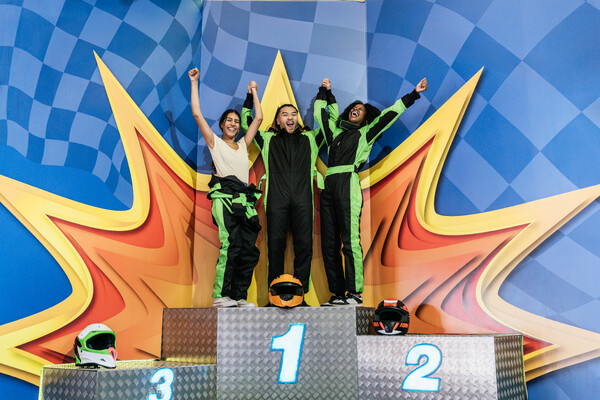
■ Head-to-head competition for a prize. Live quiz, trivia, or a timed challenge with two players going at once and a leaderboard overhead. Competition manufactures stakes, spectators, and a reason to come back and the qualifying questions can double as lead qualification or product explanations.
■ Motion-sensor physical challenges. A reflex test, a hand-eye drill, or a full-body task run on motion sensors and tied to your product’s core benefit. Physical participation creates embodiment: people don’t just watch the value proposition, they feel it in their own reaction time. How better to demonstrate your products benefits? An example of this would be testing your reflexes/cognitive in a game of Simon Says.
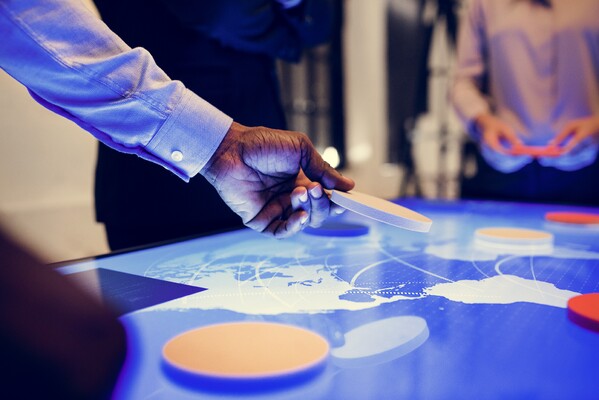
■ Interactive simulation demos. Make the invisible visible. A real-time simulation of a vehicle’s aerodynamics, a fluid-flow model, a stress test anything that lets an attendee change a variable and watch the result. It turns an abstract spec sheet into a thing people poke at and remember. An example of this would be showing the load a truck can carry in an interactive way with attendees choosing what to load in.
■ Interactive product tours. A guided 3D walkthrough of a structure, vessel, or facility a yacht’s interior, a plant floor, a building on a large touchscreen or in VR. It lets people explore a product that’s impossible to bring to the floor, on their own terms and at their own pace.
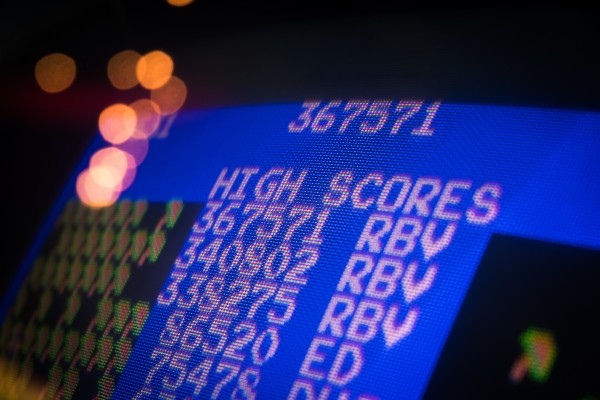
■ Branded arcade. A classic arcade or endless-runner game reskinned in your brand, with a high-score board. Instantly familiar, zero learning curve, endless replay and a magnet for a crowd that lingers. Especially good for nostalgic brands.
■ Digital instant-win mechanics. A prize wheel, plinko, or slot-style spin gated by a quick form. The five-second dopamine hit captures the contact; the prize gives staff a natural reason to start a conversation. Everyone still loves a booth giveaway.
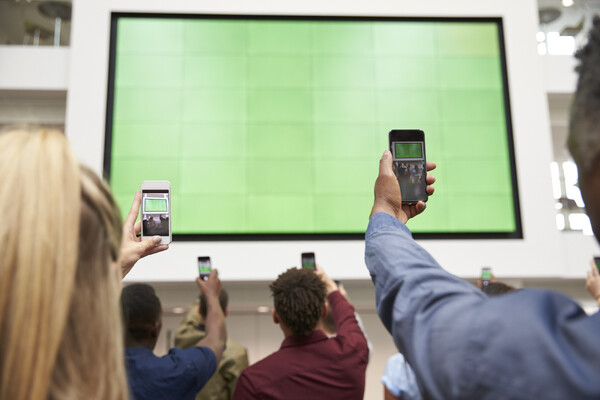
■ Big-screen multiplayer. Attendees join from their phones and compete together against a projector or video wall playing in trivia, racing, tap battles. It scales a single screen into a room-wide event and pulls people in from neighboring aisles. Added bonus adding an announcer or commentator from the team!
■ Shareable AR moments. An augmented-reality mirror, projection-mapped floor, or branded photo experience built to be filmed. Designed-to-share moments extend the booth beyond the hall the 98% who post are doing your reach for you. Give them something to share. People take selfies, give them more reasons and emotional levers to do so.
The common thread isn’t the technology screens, sensors, and projectors are just delivery. It’s that every one of these asks for participation before it asks for anything else. Interactive doesn’t always mean a screen is required. It means people are participating.
What High-Performing Booths Have in Common
Across industries and formats, the most effective interactive booths share a handful of traits:
• A visible, always-active engagement loop — something is always happening and how to join in is clear.
• No barrier to entry and no explanation required.
• Clear outcomes: a win, a score, a prize, a result, a reaction.
• Staff acting as facilitators, not presenters.
• Continuous participant turnover that creates its own momentum.
Crucially, these booths don’t replace messaging. They sequence it correctly — experience first, explanation second. The game or challenge earns the conversation; the conversation carries over to the pitch.
Rethinking ROI: From Impressions to Participation
Traditional booth metrics fixate on impressions, badge scans, and conversations initiated.
Interactive booths change the unit of measurement to a single, sharper question: how many people chose to participate without being asked?
That shift matters, because voluntary participation is a stronger predictor of recall, brand affinity, and post-event conversion than passive exposure.
85% of consumers say they’re more likely to buy after taking part in an experience, and 70% become repeat customers.
Add the fact that 72% of attendees are more likely to buy from an exhibitor they actually met at a show, and the logic compounds: interaction doesn’t just increase traffic. It increases qualified attention.
There’s a content dividend, too.
Roughly 98% of attendees create digital or social content at live experiences — and effectively all of them share it.
A leaderboard that makes someone laugh or a co-worker playing a game wielding a sword becomes a post that reaches the peers who never made it to your aisle and in some cases did not make it to the tradeshow at all, this allows you to capture that audience that is relevant but not present.
If It Can Be Ignored, It Will Be
The modern trade show floor is not short on information. It’s short on interruption. Static booths fail not because they’re poorly designed, but because they’re built for a version of attention that no longer exists in dense environments and I would argue that society in general desires more dopamine and more noteworthy experiences.
Interactive experiences games, demos, live challenges don’t just attract visitors. They change the physics of attention around a booth. And in a hall full of competing signals, the booths that win aren’t the ones that explain themselves best.
They’re the ones that make it impossible to walk past without stopping and joining in.
Helping Teams Create Products That Actually Stick
Michael Sorrenti and his team at GAME PILL help companies turn ideas into products people cannot stop using. With twenty-six plus years of experience creating booth interactive, games, AI experiences, and digital platforms for global brands like Disney, Marvel, and Nickelodeon, they guide teams to design and launch products that drive engagement, revenue, and growth.
DM “tradeshow booth” if you would like to set up a call and discuss the gamification of your booth, pop up or event!
Sources
Cvent — 47 Trade Show Statistics Shaping 2025 and Beyond. https://www.cvent.com/en/blog/events/trade-show-statistics
Exponents — The Art of Event Engagement. https://www.exponents.com/our-blog/trade-show-exhibitors-discover-the-art-of-event-engagement-to-attract-more-attention/
Exhibit Options — Measuring Experiential Marketing ROI. https://blog.exoptions.com/measure-experiential-marketing-roi
EventTrack / Limelight Platform — 45 Experiential Marketing Statistics. https://www.limelightplatform.com/blog/experiential-marketing-statistics
Cvent, ‘47 Trade Show Statistics Shaping 2025 and Beyond.’ https://www.cvent.com/en/blog/events/trade-show-statistics
Exponents, ‘Discover the Art of Event Engagement.’ https://www.exponents.com/our-blog/trade-show-exhibitors-discover-the-art-of-event-engagement-to-attract-more-attention/
Cvent, ‘47 Trade Show Statistics Shaping 2025 and Beyond.’ https://www.cvent.com/en/blog/events/trade-show-statistics
Exhibit Options, ‘Measuring Experiential Marketing ROI.’ https://blog.exoptions.com/measure-experiential-marketing-roi
EventTrack / Limelight Platform, ‘45 Experiential Marketing Statistics.’ https://www.limelightplatform.com/blog/experiential-marketing-statistics
Cvent, ‘47 Trade Show Statistics Shaping 2025 and Beyond.’ https://www.cvent.com/en/blog/events/trade-show-statistics
EventTrack / Limelight Platform, ‘45 Experiential Marketing Statistics.’ https://www.limelightplatform.com/blog/experiential-marketing-statistics